

- 10 Nov, 2026
- 10 min read
- By Kinsmen Corporate Advisory Group
- Reviewed by Senior Partner
Reviewed by Kinsmen Corporate Advisory Group · Published 10 November 2026
Quick Answer (Executive Summary):
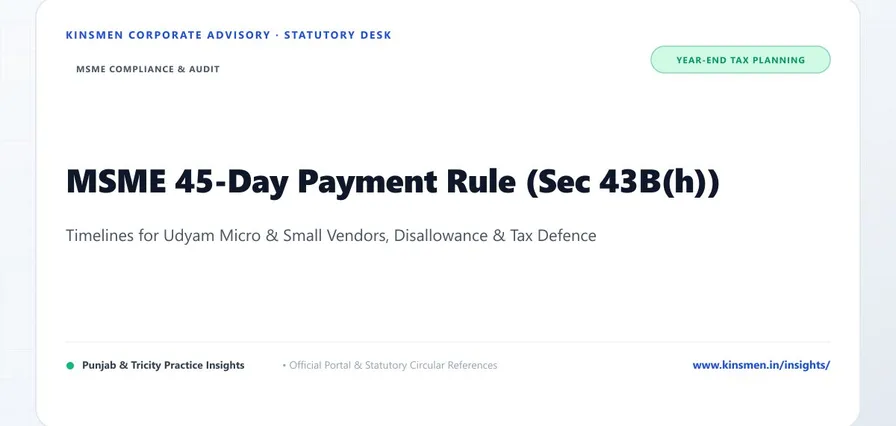
Under Section 43B(h) of the Income-tax Act, 1961 (and its successor Section 46(2) under the Income-tax Act, 2025), businesses must settle outstanding payments to Udyam-registered Micro and Small suppliers within 15 days (in the absence of a written agreement) or within 45 days (where a written contract exists). Any outstanding balance not cleared within these statutory windows by 31 March is permanently disallowed as an expense in that financial year, inflating taxable income. Dues owed to wholesale traders and medium enterprises remain exempt.
Key Takeaways
- Statutory Timelines: Mandatory payment within 15 days (without contract) or up to 45 days (with written agreement) under Section 15 of the MSMED Act.
- Year-End Disallowance: Invoices unpaid past the 15/45-day window as of 31 March are disallowed under Section 43B(h) and taxed at full rates.
- Deduction Upon Actual Payment: The disallowed expense can only be claimed in the subsequent financial year when payment is physically cleared.
- Traders & Medium Units Exempt: Does not apply to Medium enterprises or wholesale/retail traders (NIC codes 45, 46, 47).
- Compound Interest Penalty: Delayed payments attract interest at 3x the RBI bank rate (compounded monthly) under Section 16 of the MSMED Act.
- Interest Non-Deductible: Penal interest paid to MSMEs is strictly inadmissible as an expense under Section 23 of the MSMED Act.
Understanding Section 43B(h): Legislative Mandate & Scope
Enacted to protect cash-flow liquidity for micro and small suppliers, Section 43B(h) links direct tax expense deductions directly with the payment timelines codified in the Micro, Small and Medium Enterprises Development (MSMED) Act, 2006.
Unlike other provisions under Section 43B—which permit deductions if payments are made before the ITR filing due date—Section 43B(h) permits no such grace period.
Payment must occur strictly within the statutory 15-day or 45-day window:
        [Purchase of Goods/Services from MSME Supplier]
                               |
               Is Supplier Registered on Udyam?
                               |
            ---------------------------------------
            |                                     |
           NO                                    YES
            |                                     |
     Standard Credit                       Is Enterprise
    Terms Apply (No 43B(h))               Micro or Small?
                                                  |
                                      -------------------------
                                      |                       |
                                 YES (Mfg/Svc)           NO (Trader/Medium)
                                      |                       |
                              Section 43B(h)             Exempt from
                              APPLIES STRICTLY           Section 43B(h)
To classify your enterprise or secure certificates, explore our Udyam Registration Advisory.
Enterprise Classification Benchmarks: Who Qualifies Under 43B(h)?
Under the revised composite classification criteria, enterprises are categorized based on investment in plant and machinery and annual turnover:
| Enterprise Category | Investment in Plant & Machinery | Annual Turnover Threshold | Covered Under Section 43B(h)? |
|---|---|---|---|
| Micro Enterprise | Up to ₹1 Crore | Up to ₹5 Crore | YES (Strictly Covered) |
| Small Enterprise | Up to ₹10 Crore | Up to ₹50 Crore | YES (Strictly Covered) |
| Medium Enterprise | Up to ₹50 Crore | Up to ₹250 Crore | NO (Exempt) |
| Wholesale / Retail Traders | Any (NIC 45, 46, 47) | Any | NO (Exempt by CBDT / MSME OM) |
Important: Both investment and turnover thresholds must be satisfied. If an enterprise exceeds either limit, it moves to the next higher classification.
For comprehensive ledger auditing, check our Accounting & Bookkeeping Services.
The 15-Day vs 45-Day Payment Rule Explained
Section 15 of the MSMED Act establishes two alternative payment cut-offs:
1. Where There Is No Written Agreement (15 Days)
If a buyer purchases raw materials or components without an executed commercial contract specifying credit terms, the buyer must make payment on or before the 15th day from the date of physical delivery of the goods or services.
2. Where There Is a Written Agreement (Up to 45 Days)
If the buyer and supplier execute a written contract or terms of sale (such as a formal purchase order accepted by the supplier) detailing credit days, payment can be extended up to the agreed period. However, Section 15 explicitly prohibits the agreed credit period from exceeding 45 days.
Any clause in a commercial contract stipulating 60, 90, or 120 days is void under law, and the statutory limit remains capped at 45 days.
Financial Impact of Section 43B(h) Disallowance: A Practical Example
Consider a manufacturing firm in Ludhiana purchasing raw yarn worth ₹30,00,000 from a micro spinning unit in Malerkotla on 10 February 2027:
| Scenario | Payment Date | Credit Days | Section 43B(h) Status | Tax Impact for FY 2026–27 |
|---|---|---|---|---|
| Scenario A | 25 March 2027 | 43 Days (Within 45) | Allowed | Full ₹30 Lakh deducted; normal tax |
| Scenario B | 05 April 2027 | 54 Days (Past 45, but paid before ITR) | DISALLOWED | ₹30 Lakh added back to profit; ₹9.36 Lakh tax paid for FY 2026–27 |
| Scenario C | 15 May 2027 | Cleared in FY 2027–28 | Deduction Deferred | Claimed as deduction in FY 2027–28 upon actual payment |
In Scenario B, even though the bill was paid before the income tax return was filed in October 2027, the deduction is denied for FY 2026–27 because it was not settled within 45 days and remained unpaid as of 31 March 2027.
Where audit reports require clause 22 verification, see our Tax Audit Section 44AB Practice.
Section 16 Interest Penalty: Compounded at 3x the RBI Bank Rate
Failing to pay micro and small suppliers within statutory deadlines triggers substantial direct and indirect financial penalties:
1. Mandatory Compound Interest
Under Section 16 of the MSMED Act:
- The buyer is liable to pay compound interest with monthly rests on the overdue amount.
- The interest rate is fixed at three times the Bank Rate published by the Reserve Bank of India (e.g., if the RBI Bank Rate is 6.75%, the penal interest rate is 20.25% per annum).
2. Section 23 Inadmissibility
Under Section 23 of the MSMED Act, any interest paid or payable to an MSME supplier under Section 16 shall not be allowed as a deduction when computing income under the Income-tax Act.
The buyer absorbs this high interest cost entirely out of post-tax profits.
For corporate structure optimization, explore our Corporate Tax Planning advisory.
Step-by-Step Year-End MSME Compliance Action Plan for Buyers
To prepare your business for the 31 March year-end close and prevent tax audit disallowances:
- Step 1: Circularize Vendor Database
Issue a formal compliance declaration letter to all active creditors requesting their Udyam Registration Number (URN) and activity classification. - Step 2: Validate URNs on the Udyam Portal
Access udyamregistration.gov.in/Udyam_Verify.aspx to confirm whether each registered vendor is categorized as a Manufacturer, Service Provider, or Trader. - Step 3: Establish Formal Written Credit Terms
Ensure all purchase orders, purchase contracts, and proforma invoices specify written payment terms not exceeding 45 days. - Step 4: Prepare Aging Analysis of Creditors
Generate an accounts payable aging report as of 15 February and 15 March. Flag every Udyam Micro and Small creditor whose invoice exceeds 30 days. - Step 5: Prioritize Payments Before 31 March
Clear all flagged Udyam micro and small invoices before 31 March to ensure full tax deductibility for the financial year.
For broader accounting systems review, read our guide on Effective Accounting Practices for Small Businesses.
Local Punjab Guidance: Ludhiana, Malerkotla, Amargarh & Ahmedgarh
The 43B(h) rule impacts key commercial supply chains across central Punjab:
- Ludhiana Engineering, Bicycle & Fastener Clusters: Large assemblers buying nuts, bolts, plating services, and cycle parts from small job-work units must track 45-day cycles to avoid substantial tax additions in annual audits.
- Malerkotla Textile Power Looms & Dyers: Fabric merchants purchasing grey yarn from small spinning units must maintain strict purchase registers to ensure raw material expenses are not disallowed.
- Ahmedgarh Agricultural Implement Fabricators: Machinery manufacturers buying laser-cut steel plates and forged pins from micro suppliers must formalize purchase orders with 45-day credit terms.
- Amargarh Grain Mandi Commission Agents: Agricultural commission agents dealing with packaging and transport suppliers must verify whether local service providers hold Udyam certificates.
Kinsmen Corporate Services advises commercial clients across Ludhiana, Malerkotla, Ahmedgarh, and Amargarh from our registered office.
Frequently Asked Questions
What is the 43B(h) MSME payment rule and what are the statutory timelines?
Under Section 43B(h) of the Income-tax Act, 1961 (and Section 46(2) under the Income-tax Act, 2025), any sum owed to an Udyam-registered Micro or Small enterprise for goods or services must be paid within the timeline specified in Section 15 of the MSMED Act, 2006: within 15 days if there is no written agreement, or within the agreed period up to a maximum of 45 days if a written contract exists.
What happens if a buyer fails to pay a micro or small supplier within 45 days?
If the payment is not made within 15 or 45 days and remains outstanding as of 31 March of the financial year, the entire unpaid expenditure is disallowed as a tax deduction under Section 43B(h) for that year. The amount is added back to the buyer’s net business income and taxed at the full corporate or business tax rate. The deduction is allowed only in the subsequent financial year in which the payment is actually made.
Does Section 43B(h) apply to purchases from wholesale or retail traders?
No. Although retail and wholesale traders are eligible to register on Udyam under NIC codes 45, 46, and 47 for priority sector lending, the Ministry of MSME and CBDT have clarified that trade benefits under Chapter V of the MSMED Act do not apply to traders. Therefore, Section 43B(h) disallowance does not apply to dues owed to traders, but only to manufacturing and service enterprises.
Does the 43B(h) rule apply to medium enterprises or unregistered suppliers?
No. Section 43B(h) applies exclusively to Micro and Small enterprises that hold valid Udyam Registration. It does not apply to Medium enterprises (turnover up to ₹250 Crore) or suppliers who have not registered on the Udyam portal.
What is the statutory interest penalty on delayed payments under the MSMED Act?
Under Section 16 of the MSMED Act, 2006, delayed payment to an MSME supplier attracts mandatory penal interest at three times the Bank Rate notified by the Reserve Bank of India (RBI), compounded on a monthly basis. Crucially, under Section 23 of the MSMED Act, this penal interest is non-deductible when computing taxable business income.
How can businesses in Punjab verify whether their vendors are micro or small enterprises?
Businesses should issue a formal annual vendor verification letter requiring all suppliers to submit a copy of their Udyam Registration Certificate and verify the enterprise category (Micro, Small, or Trader) online via the official udyamregistration.gov.in verification portal.
Official Government Portals & Statutory Sources
- Ministry of Micro, Small & Medium Enterprises: msme.gov.in — MSMED Act, 2006 statutory guidelines and circulars.
- Udyam Verification Portal: udyamregistration.gov.in — Online Udyam registration status and enterprise category verification.
- Income Tax Department of India: incometax.gov.in — Tax audit reporting utilities and Form 3CD Clause 22 disclosures.
Audit Your MSME Payables with Kinsmen
Prevent substantial income tax disallowances and Section 16 compound interest liabilities. Contact our direct tax and accounting desk in Amargarh to audit your creditors ledger before 31 March.
- Direct Phone: +91 99143-14949
- WhatsApp Inquiry: Direct WhatsApp Consultation
- Office Location: Shop No. 1, Nabha Malerkotla Road, Amargarh – 148022, District Malerkotla, Punjab
- Online Form: Schedule a Compliance Review via Contact Desk
Have a question about how this applies to your business?
Speak directly with our senior compliance partners in Amargarh. We review your entity structure, notices, and pending filings with zero middlemen.
Related Advisory & Compliance Execution
Need professional assistance with filing, notice defense, or entity structuring?
Partnership Firm Registration (Sec 58)
Custom partnership deed drafting compliant with revised Section 194T.
Tax Audit Facilitation (Section 44AB)
Form 3CD compilation, ledger vouching, and disallowance defenses.
Corporate Tax Planning & Advance Tax
Quarterly tax liability computation and 115BAA corporate opt-in advisory.
Related Practice Insights
More statutory analysis and practical compliance guides
Advance Tax Due Date December 2026: 3rd Instalment Calculation in Punjab
Advance tax due date December 2026: 75% cumulative tax by 15 Dec. Learn Section 234C & 234B interest calculations, senior citizen exemptions, and Punjab rules.
Learn More Advance Tax Due Date December 2026: 3rd Instalment Calculation in Punjab
AOC-4 MGT-7 Due Date FY 2025-26: MCA Annual Filing Rules for Punjab Companies
AOC-4 MGT-7 due date for FY 2025-26: 30 & 60 days post-AGM. Learn MCA late fee of ₹100/day, director KYC rules, LLP Form 11/8, and Punjab filing steps.
Learn More AOC-4 MGT-7 Due Date FY 2025-26: MCA Annual Filing Rules for Punjab Companies
Belated ITR Last Date 2026: Section 139(4), Fees & Loss Rules for AY 2026-27
Belated ITR last date for AY 2026-27 is 31 Dec 2026. Learn late fee u/s 234F, loss carry-forward rules, revision steps u/s 139(5), and ITR-U penalty rates.
Learn More Belated ITR Last Date 2026: Section 139(4), Fees & Loss Rules for AY 2026-27