

- 10 Nov, 2026
- 9 min read
- By Kinsmen Corporate Advisory Group
- Reviewed by Senior Partner
Reviewed by Kinsmen Corporate Advisory Group · Published 10 November 2026
Quick Answer (Executive Summary):
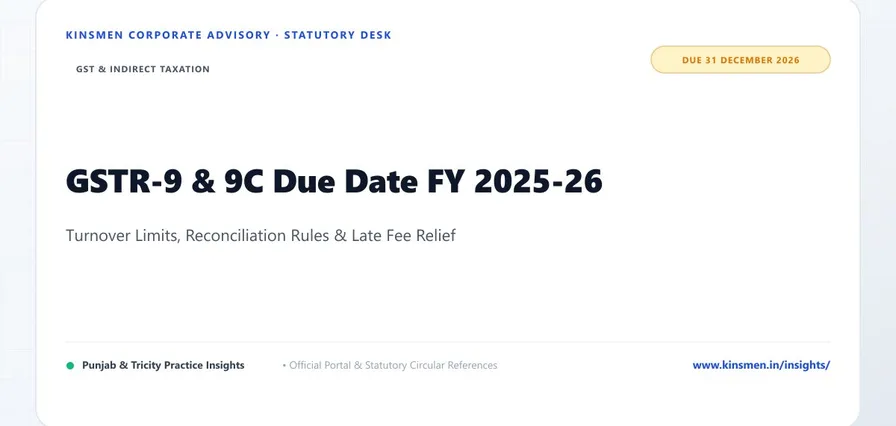
The statutory deadline to file annual GST returns GSTR-9 and self-certified reconciliation statements GSTR-9C for Financial Year 2025–26 is 31 December 2026. Filing is optional for regular taxpayers with an aggregate turnover up to ₹2 Crore, mandatory for businesses above ₹2 Crore, and accompanied by GSTR-9C for businesses with annual turnover exceeding ₹5 Crore. Because missed input tax credit cannot be reclaimed in GSTR-9, businesses in Punjab must perform rigorous purchase register audits and settle any tax discrepancies via Form DRC-03.
Key Takeaways
- Due Date: 31 December 2026 is the statutory cut-off for GSTR-9 and GSTR-9C for FY 2025–26.
- ₹2 Crore Exemption: Regular taxpayers with pan-India aggregate turnover up to ₹2 Crore are legally exempt from filing GSTR-9.
- ₹5 Crore Threshold for GSTR-9C: Enterprises exceeding ₹5 Crore turnover must submit Form GSTR-9C reconciled with audited balance sheets.
- Self-Certification Protocol: GSTR-9C is self-certified by the taxpayer; Kinsmen coordinates data verification and ledger reconciliation.
- No Fresh ITC Mechanism: Unclaimed ITC for FY 2025–26 cannot be availed in GSTR-9; it lapsed on 30 November 2026.
- Tax Payment Channel: Additional tax liabilities identified in GSTR-9 must be discharged voluntarily via Form DRC-03 in cash with 18% interest under Section 50.
What Is the Turnover Limit for GSTR-9 and GSTR-9C for FY 2025-26?
The Central Board of Indirect Taxes and Customs (CBIC) continues its calibrated compliance relief for small and medium enterprises.
Turnover benchmarks for FY 2025–26 are defined as follows:
| Aggregate Annual Turnover | GSTR-9 Filing Requirement | GSTR-9C Reconciliation Requirement | Late Fee Applicability |
|---|---|---|---|
| Up to ₹2 Crore | Exempt / Optional | Not Applicable | Nil (if opted out) |
| ₹2 Crore to ₹5 Crore | Mandatory | Not Applicable | ₹50 / day (max 0.04% turnover) |
| Above ₹5 Crore | Mandatory | Mandatory (Self-Certified) | ₹200 / day (max 0.5% turnover) |
Note: Aggregate turnover includes the total value of all taxable, exempt, export, and inter-state supplies across all GSTINs registered under the same PAN across India.
To ensure your outward supplies and purchase registers match official portal data, review our GSTR-2B Reconciliation service.
Who Must File GSTR-9, and Who Is Specifically Exempt?
Required to File GSTR-9:
- All regular taxpayers whose aggregate annual turnover exceeded ₹2 Crore in FY 2025–26.
- Businesses that migrated from the regular scheme to the composition scheme (or vice versa) during FY 2025–26, for the period under the regular scheme.
- Special Economic Zone (SEZ) units and developers holding active GST registrations.
Specifically Exempt from GSTR-9:
- Taxpayers registered under the Composition Scheme under Section 10 (they file annual return Form GSTR-4).
- Input Service Distributors (ISD) filing Form GSTR-6.
- Non-Resident Taxable Persons (NRTP) and Casual Taxable Persons (CTP).
- Entities liable to deduct TDS under Section 51 (Form GSTR-7) or collect TCS under Section 52 (Form GSTR-8).
- Online Information Database Access and Retrieval (OIDAR) service providers.
Explore our comprehensive return management solutions on our GST Return Filing desk.
How to Reconcile GSTR-1, GSTR-3B and Audited Books
Annual GST filing is primarily a mathematical and legal reconciliation between three distinct data sets:
- Outward Supplies: Revenue reported in monthly GSTR-1 returns.
- Tax Discharged: Tax liabilities declared and settled in monthly GSTR-3B returns.
- Audited Financials: Gross receipts, turnover, and other income shown in Profit & Loss statements.
       [Audited Financial Accounts]
                    |
      Reconcile Turnover & Tax Rates
                    |
       [Form GSTR-1 Outward Files]
                    |
      Match Tax Payments & Credits
                    |
        [Form GSTR-3B Cash/ITC]
                    |
        -------------------------
        |                       |
   Discrepancies           Discrepancies
     in Sales                in Input Credit
        |                       |
  Report in GSTR-9        Table 8D Reconcile
  Pay via DRC-03 Cash     Ineligible ITC Reversal
Critical Problem Areas in Table 8D (ITC Reconciliation):
- Table 8A Auto-Population: Represents ITC reflected in suppliers’ GSTR-1/IFF filings.
- Table 8B: Represents ITC availed in GSTR-3B during FY 2025–26.
- Table 8C: Represents ITC for FY 2025–26 availed in GSTR-3B returns between April 2026 and October 2026 (filed up to 30 November 2026).
- Negative Table 8D: If Table 8D is negative, it indicates excess ITC was claimed compared to supplier filings, triggering automated scrutiny notices under Rule 88D.
For broader registration insights, read our analysis on 3-Day Simplified GST Registration in Punjab.
Step-by-Step Procedure to Prepare and File Form GSTR-9
To ensure accuracy and avoid penalty notices from state and central tax circles, follow this sequential procedure:
- Download System-Generated GSTR-9 Summary:
Log in to gst.gov.in, navigate to Returns Dashboard > Annual Return > FY 2025–26, and download the auto-drafted GSTR-9, GSTR-1 summary, and GSTR-3B summary. - Reconcile Outward Turnover (Tables 4 & 5):
Segregate B2B supplies, B2C supplies, zero-rated exports, nil-rated sales, and non-GST income. Ensure turnover agrees with financial statements. - Classify Inward ITC (Table 6):
Break down claimed ITC into Inputs, Input Services, and Capital Goods to maintain compliance with reporting standards. - Account for Reversals (Table 7):
Report mandatory reversals under Rule 37 (180-day non-payment to vendors), Rule 42 (common ITC for exempt supplies), and Rule 43 (capital goods). - Compute Differential Liabilities & Form DRC-03:
If tax liabilities were under-reported in GSTR-3B, compute unpaid CGST/SGST/IGST and pay via Form DRC-03 choosing “Annual Return” cause. - Self-Certify GSTR-9C (Turnover > ₹5 Crore):
Draft the reconciliation statement between audited annual turnover and GST turnover, detailing reasons for unreconciled differences. - Submit with DSC or EVC:
Verify with Class-3 Digital Signature Certificate (DSC) for companies and LLPs, or Aadhaar OTP (EVC) for proprietorship firms.
Learn more on our dedicated GSTR-9 Annual Return Filing service page.
Common Mistakes and Penalties for Late Filing
Filing GSTR-9 with inaccurate figures or missing the 31 December 2026 due date carries specific statutory consequences:
| Non-Compliance Issue | Legal Provision | Statutory Consequence / Penalty |
|---|---|---|
| Late Filing (Turnover $\le$ ₹5 Cr) | Section 47(2) CGST Act | ₹50 per day (₹25 CGST + ₹25 SGST), capped at 0.04% of state turnover |
| Late Filing (Turnover > ₹5 Cr) | Section 47(2) CGST Act | ₹200 per day (₹100 CGST + ₹100 SGST), capped at 0.50% of state turnover |
| Short Payment of Outward Tax | Section 50(1) CGST Act | Mandatory interest at 18% per annum from original due date until cash settlement |
| Wrong / Excess ITC Availed & Utilized | Section 50(3) CGST Act | Mandatory interest at 24% per annum on utilized inadmissible ITC |
| Omission of HSN Summary | Table 17 & 18 | Rejection of submission or general penalty under Section 125 up to ₹25,000 |
If you receive an automated discrepancy notice, read how we prepare replies on our GST Notice Reply desk.
Local Punjab Guidance: Ludhiana, Patiala, Malerkotla & Mohali
Firms operating in Punjab’s industrial belts face distinct annual return reconciliation challenges:
- Ludhiana Textile & Engineering Units: High volume of post-sale credit notes for yarn and cycle parts requires precise adjustments in Table 4I/4J. Mismatches between e-way bill portals and e-invoices must be reconciled.
- Patiala & Nabha Agro-Fabricators: Sale of agricultural implements, combine parts, and steel structures must distinguish between 12%, 18%, and exempt supplies in Table 5.
- Malerkotla Cold Storages & Food Processors: Segregating exempt agricultural storage operations from commercial cold-chain transport services is essential to prevent incorrect ITC reversals under Rule 42.
- Mohali Technology & Software Exporters: Service exports executed under Letter of Undertaking (LUT) must be reconciled with FIRC/e-BRC remittances in Table 6A.
Kinsmen Corporate Services coordinates comprehensive GST data audits for clients across Ludhiana, Patiala, and Mohali from our headquarters in Malerkotla.
Frequently Asked Questions
What is the official GSTR-9 and GSTR-9C due date for FY 2025-26?
The statutory due date for filing GSTR-9 (Annual Return) and GSTR-9C (Reconciliation Statement) for Financial Year 2025–26 is 31 December 2026. Taxpayers are advised to complete filings well before the deadline to prevent portal errors and daily late fees.
What is the turnover threshold for mandatory GSTR-9 filing for FY 2025-26?
Under CBIC notifications, registered taxpayers with aggregate annual turnover up to ₹2 Crore in FY 2025–26 are exempt from mandatory GSTR-9 filing. For businesses with aggregate turnover exceeding ₹2 Crore, GSTR-9 is mandatory. If turnover exceeds ₹5 Crore, filing self-certified GSTR-9C is also mandatory.
Is a Chartered Accountant certification mandatory for GSTR-9C?
No. GSTR-9C is a self-certified reconciliation statement executed by the taxpayer under Section 44 of the CGST Act. However, where an enterprise is subject to mandatory statutory audit under company law or the Income-tax Act, Kinsmen coordinates reconciliation with financial books and independent practicing Chartered Accountants.
What is the daily late fee for filing GSTR-9 after 31 December 2026?
Under Section 47 of the CGST Act, taxpayers with turnover up to ₹5 Crore incur a daily late fee of ₹50 per day (₹25 CGST + ₹25 SGST), capped at 0.04% of turnover in the state. For taxpayers with turnover exceeding ₹5 Crore, the fee is ₹200 per day (₹100 CGST + ₹100 SGST), capped at 0.5% of turnover.
Can I claim missed Input Tax Credit (ITC) for FY 2025-26 in GSTR-9?
No. GSTR-9 is strictly a consolidation return; you cannot claim fresh ITC for the previous financial year in Form GSTR-9. The statutory deadline to claim missed ITC for FY 2025–26 was 30 November 2026 in monthly Form GSTR-3B.
How should short-paid GST identified during GSTR-9 compilation be paid?
Any unpaid tax liability or excess ITC claimed during FY 2025–26 that is uncovered during annual reconciliation must be discharged voluntarily through Form DRC-03 in cash, along with applicable interest at 18% per annum under Section 50.
Official Government Portals & Statutory Sources
- GST System Portal: gst.gov.in — GSTR-9 and GSTR-9C electronic filing and offline utility download.
- Central Board of Indirect Taxes and Customs: cbic-gst.gov.in — CGST Rule 80, annual return turnover exemption notifications, and circulars.
- GST Council Secretariat: gstcouncil.gov.in — Policy decisions and legal recommendations on annual compliance.
Consult Kinsmen for Annual GST Filing
Ensure your GSTR-9 and GSTR-9C submissions are reconciled with zero mismatch notices. Contact our direct indirect tax practice team in Amargarh.
- Direct Phone: +91 99143-14949
- WhatsApp Inquiry: Direct WhatsApp Consultation
- Office Location: Shop No. 1, Nabha Malerkotla Road, Amargarh – 148022, District Malerkotla, Punjab
- Online Form: Request an Annual GST Audit Consultation
Have a question about how this applies to your business?
Speak directly with our senior compliance partners in Amargarh. We review your entity structure, notices, and pending filings with zero middlemen.
Related Advisory & Compliance Execution
Need professional assistance with filing, notice defense, or entity structuring?
Partnership Firm Registration (Sec 58)
Custom partnership deed drafting compliant with revised Section 194T.
Tax Audit Facilitation (Section 44AB)
Form 3CD compilation, ledger vouching, and disallowance defenses.
Corporate Tax Planning & Advance Tax
Quarterly tax liability computation and 115BAA corporate opt-in advisory.
Related Practice Insights
More statutory analysis and practical compliance guides
Advance Tax Due Date December 2026: 3rd Instalment Calculation in Punjab
Advance tax due date December 2026: 75% cumulative tax by 15 Dec. Learn Section 234C & 234B interest calculations, senior citizen exemptions, and Punjab rules.
Learn More Advance Tax Due Date December 2026: 3rd Instalment Calculation in Punjab
AOC-4 MGT-7 Due Date FY 2025-26: MCA Annual Filing Rules for Punjab Companies
AOC-4 MGT-7 due date for FY 2025-26: 30 & 60 days post-AGM. Learn MCA late fee of ₹100/day, director KYC rules, LLP Form 11/8, and Punjab filing steps.
Learn More AOC-4 MGT-7 Due Date FY 2025-26: MCA Annual Filing Rules for Punjab Companies
Belated ITR Last Date 2026: Section 139(4), Fees & Loss Rules for AY 2026-27
Belated ITR last date for AY 2026-27 is 31 Dec 2026. Learn late fee u/s 234F, loss carry-forward rules, revision steps u/s 139(5), and ITR-U penalty rates.
Learn More Belated ITR Last Date 2026: Section 139(4), Fees & Loss Rules for AY 2026-27