

- 10 Nov, 2026
- 11 min read
- By Kinsmen Corporate Advisory Group
- Reviewed by Senior Partner
Reviewed by Kinsmen Corporate Advisory Group · Published 10 November 2026
Quick Answer (Executive Summary):
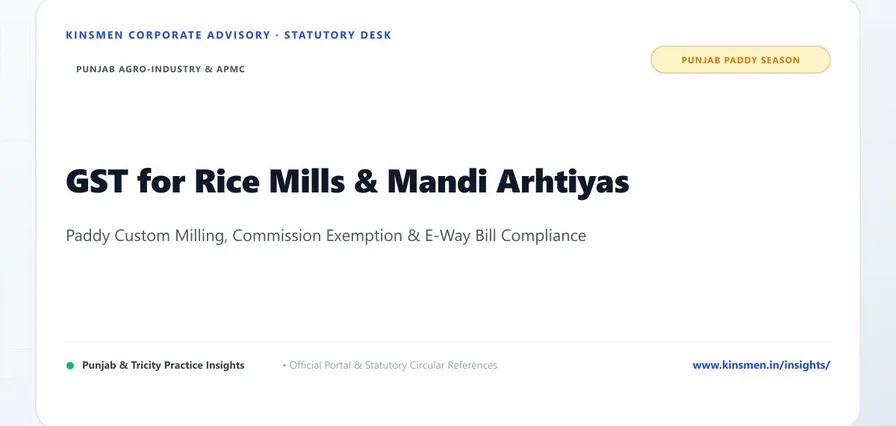
During the annual Kharif paddy procurement season in Punjab, rice shellers and grain mandi commission agents (arhtiyas) must navigate a specialized tax matrix. Key regulatory rules include: a 5% GST rate on custom milling of paddy (CMR) job-work charges; an explicit GST exemption for Kacha Arhtiyas acting as commission agents for agricultural produce; 5% GST on pre-packaged rice under 25 kg versus 0% on bulk loose rice; and statutory exemptions from Section 194Q TDS for direct purchases from farmers.
Key Takeaways
- CMR Job Work Rate: Custom milling of paddy into rice attracts 5% GST under Notification No. 11/2017-CT(R).
- Arhtiya Commission Exemption: Services provided by Kacha Arhtiyas for agricultural produce are exempt from GST under Notification No. 12/2017-CT(R).
- Packaged vs Loose Rice: Pre-packaged and labelled rice bags (up to 25 kg) carry 5% GST; loose bulk grain exceeding 25 kg is exempt (0%).
- Input Credit Eligibility: Shellers can claim full 18% ITC on rice milling machinery, color sorters, packaging bags, and plant maintenance.
- Section 194Q TDS Relief: Payments made to farmers for direct agricultural produce are exempt from the 0.1% TDS on purchase of goods.
- Punjab Milling Hubs: Kinsmen provides integrated stock audits and GST filings for shellers and mandis across Sangrur, Malerkotla, Nabha, and Barnala.
The Regulatory Framework for Punjab’s Paddy Procurement Ecosystem
Punjab is the breadbasket of India, procuring over 120 Lakh metric tonnes of paddy annually during the October to December Kharif season.
The procurement cycle operates through a tripartite statutory relationship involving:
- The Farmer: Selling raw paddy in regulated APMC grain mandis.
- The Mandi Commission Agent (Arhtiya): Facilitating auctions, weighing, and clearing under the Punjab Agricultural Produce Markets Act, 1961.
- The Rice Sheller / Mill: Milling raw paddy into Custom Milled Rice (CMR) on behalf of government procurement agencies (Pungrain, Markfed, Punsup, PSWC, and FCI) or for private commercial sale.
Each tier in this supply chain carries distinct Goods and Services Tax (GST) and direct tax obligations.
For dedicated legal representation, explore our GST Consultant Desk.
GST Rates and Classification for Rice Shellers and Mandi Produce
The following table summarizes current GST rates across paddy procurement, milling, by-products, and trade operations:
| Item / Supply Category | HSN / SAC Code | Applicable GST Rate | Invoicing & Reporting Notes |
|---|---|---|---|
| Raw Unhusked Paddy | HSN 1006 10 | 0% (Nil Rated) | Agricultural produce in natural form |
| Custom Milling Job Work (CMR) | SAC 9988 | 5% (2.5% CGST + 2.5% SGST) | Applicable to milling charges billed to state agencies |
| Pre-Packaged & Labelled Rice | HSN 1006 30 | 5% (2.5% CGST + 2.5% SGST) | Pre-packaged in bags up to 25 kg |
| Loose / Non-Packaged Rice | HSN 1006 30 | 0% (Exempt) | Non-pre-packaged or bulk bags exceeding 25 kg |
| Paddy Husk / Chaff | HSN 1213 | 0% (Exempt) | By-product sold for cattle feed or boiler fuel |
| Rice Bran (De-Oiled Cake) | HSN 2306 | 0% (Exempt) | Animal / poultry feed ingredient |
| Raw Rice Bran (High Oil) | HSN 2306 | 5% | Sold to solvent extraction plants for bran oil |
| Broken Rice (Tota / Kani) | HSN 1006 40 | 5% (Packaged) / 0% (Loose) | Sold to distilleries or starch manufacturers |
To understand the core legal distinctions between agent categories, see our GST consultant desk for a case-by-case review of your arhtiya structure.
Custom Milled Rice (CMR): GST Accounting for Government Contracts
Under agreements executed between rice millers and state procurement agencies in Punjab, millers receive raw paddy belonging to the government, store it, process it, and deliver finished rice adhering to Food Corporation of India (FCI) uniform specifications:
        [State Agency (Pungrain/Markfed)]
                       |
         Supplies Raw Paddy to Sheller
               (Ownership Retained)
                       |
          [Rice Sheller Processes Paddy]
                       |
       Delivers 67% Rice Ratio to FCI Depot
                       |
     -------------------------------------
     |                                   |
  Billed Milling Charges               By-Products Retained
   (5% GST Charged on                  (Bran sold at 5%;
    Job Work Invoice)                   Husk sold at 0%)
Key Accounting Points for CMR:
- Job Work Valuation: Milling charges paid by procurement agencies (typically ₹10 to ₹25 per quintal) are taxable at 5% GST.
- Custodial Paddy Not a Sale: Delivery of raw paddy by the state agency to the mill does not constitute a taxable supply under Section 7 of the CGST Act; it is a movement of goods for job work under Section 143.
- Gunny Bags Credit: Millers receiving old or new Jute HDPE bags for packing government rice can claim full input tax credit on bag purchases.
- By-Product Realization: Under official milling policies, millers retain secondary by-products (rice husk and high-oil bran) as compensation for out-turn milling ratios. Sales of raw bran to solvent extraction units must be invoiced with 5% GST.
Kacha Arhtiyas vs Pucca Arhtiyas: Commission Taxation & Exemption
In Punjab grain markets, commission agents represent two distinct statutory personas:
1. Kacha Arhtiyas (Exempt Under Notification 12/2017)
- Acts strictly as an agent facilitating the sale of raw agricultural produce between the farmer and the buyer.
- Does not take ownership, does not issue sales invoices in their own name, and does not determine price.
- GST Exemption: Under Entry 54 of Notification No. 12/2017-Central Tax (Rate), services relating to the cultivation of plants and rearing of life forms for agricultural produce—including commission agency services—are wholly exempt from GST.
- Turnover Exclusion: Commission received by a Kacha Arhtiya is excluded when computing aggregate turnover for mandatory GST registration under Section 22, provided they conduct no other taxable business.
2. Pucca Arhtiyas (Taxable at 18% GST)
- Trades on their own account, purchases agricultural produce from farmers, stocks it, and resells it to processors or millers.
- Invoices the goods in their own corporate name and guarantees payment.
- GST Liability: Services of a Pucca Arhtiya are categorized as commercial brokerage/trading, taxable at 18% GST (SAC 9961/9985).
E-Way Bill & Movement Challan Rules in the Paddy Belt
Transporting paddy from mandis to shellers, and from shellers to FCI storage depots, requires strict transport documentation under Rule 138 of the CGST Rules:
- Delivery Challan Under Rule 55:
When transporting raw paddy from an APMC market yard to a rice sheller for custom milling, the movement must be accompanied by a valid Delivery Challan stating “Goods Dispatched for Job Work”. - E-Way Bill Generation:
An E-Way Bill is mandatory if the consignment value exceeds ₹50,000. For custom milling, the E-Way bill should indicate sub-type “Job Work”. - Mandi Movement Relaxations:
Within Punjab, local movements of non-taxable agricultural produce directly from harvest mandis to storage shellers within the same district are subject to state transit relaxations, provided the APMC gate pass and mandi purchase voucher accompany the vehicle.
For automated transport documentation, explore our E-Invoicing & E-Way Bill Practice.
TDS on Purchase of Goods (Old Section 194Q) for Rice Millers
Large rice shellers with annual turnovers exceeding ₹10 Crore must manage direct tax withholding on grain purchases:
| Direct Tax Section | Governing Transaction | Statutory Threshold | Withholding Rate | Applicability to Rice Mills |
|---|---|---|---|---|
| Section 393(1) (old 194Q) | Purchase of Goods | Aggregate purchases > ₹50 Lakh | 0.1% | Exempt on direct purchases from farmers; Mandatory on purchases from commercial traders |
| Old Section 206C(1H) | Sale of Goods (TCS) | — | — | No longer applies. TCS on sale of goods was withdrawn from 1 April 2025, so only the buyer’s TDS on purchase of goods remains |
| Section 40A(3) | Cash Payments | Payments exceeding ₹10,000 / day | Full Disallowance | Exempt under Rule 6DD(e) for cash paid to cultivators for raw agricultural produce |
Crucial Safe Harbor: Under Rule 6DD(e) of the Income-tax Rules, cash payments exceeding ₹10,000 made directly to agricultural cultivators for the purchase of agricultural produce are completely protected from Section 40A(3) disallowance.
For bank limit monitoring and audits, review our Stock Audit for Bank desk.
Local Punjab Advisory: Sangrur, Malerkotla, Nabha & Barnala
Punjab’s central rice milling belt features specific operational dynamics during the paddy season:
- Sangrur District (Sunam, Dhuri, Dirba): Massive concentration of modern parboiled rice mills requiring high working capital lines. Millers must align daily physical stock ledgers with bank CC drawing power statements.
- Malerkotla (Amargarh & Malerkotla Mandis): Vegetable and paddy markets where arhtiyas handle high transaction velocity. Commission ledgers must be reconciled to distinguish between exempt mandi dami and taxable transportation reimbursements.
- Nabha & Patiala Paddy Belts: Large multi-stage mills processing basmati and non-basmati varieties must ensure packaging credit registers strictly separate 5% packaged rice stocks from bulk export consignments.
- Barnala (Tapa & Mehal Kalan): Private shellers must ensure Section 194Q is deducted on purchases from commercial traders while maintaining farmer declaration certificates for exempt procurement.
Kinsmen Corporate Services advises rice millers and commission agents across Sangrur, Malerkotla, Nabha, and Barnala from our headquarters in Amargarh.
Frequently Asked Questions
What is the GST rate on Custom Milled Rice (CMR) job work in Punjab?
Under CBIC circulars and Notification No. 11/2017-Central Tax (Rate), job work services involving the milling of paddy into rice for state procurement agencies (such as Pungrain, Markfed, and Punsup) or private traders attract GST at the rate of 5% (2.5% CGST + 2.5% SGST). Rice millers can claim full Input Tax Credit (ITC) on gunny bags, packaging, machinery spares, and electricity.
Is arhtiya commission (dami) in Punjab grain mandis subject to GST?
Under Notification No. 12/2017-Central Tax (Rate), commission charged by a Kacha Arhtiya acting as an agent for agricultural produce (paddy and wheat) is completely exempt from GST. However, if a Pucca Arhtiya trades in their own name, takes title to goods, or charges commission on processed non-agricultural goods, their services are taxable at 18% GST.
Is GST applicable on the sale of rice in India?
Under amended GST tariff notifications, pre-packaged and labelled rice (in containers, packets, or bags up to 25 kg) is subject to 5% GST. Loose, unbranded rice sold in bulk gunny bags exceeding 25 kg or non-pre-packaged grain remains exempt from GST (0% rate).
When is an E-Way Bill mandatory for transporting paddy and rice in Punjab?
An electronic E-Way Bill is mandatory for transporting consignments of paddy or rice where the consignment value exceeds ₹50,000. However, intra-state transportation of raw agricultural produce directly from agricultural farms or grain mandis to local rice shellers is subject to specific movement challan relaxations under Punjab State GST rules.
How does Section 194Q TDS apply to paddy purchases by rice shellers?
Under Section 194Q of the Income-tax Act, a rice sheller whose annual turnover exceeded ₹10 Crore in the preceding financial year must deduct TDS at 0.1% on purchase of goods from a resident seller exceeding ₹50 Lakh in a financial year. However, purchases made directly from farmers selling their own agricultural produce in grain mandis are exempt from Section 194Q.
Can rice shellers claim ITC on rice milling machinery and plant investments?
Yes. Capital goods such as color sorters, paddy cleaners, de-huskers, bucket elevators, and parboiling dryers carry eligible ITC (typically at 18%), which can be fully utilized to offset the 5% output tax liability on custom milling and commercial rice sales.
Official Government Portals & Statutory Sources
- Goods and Services Tax Portal: gst.gov.in — E-Way bill generation, GSTR-1, and 5% job-work return filing.
- Punjab Mandi Board: mandiboard.nic.in — APMC market fee schedules, dami rates, and gate pass circulars.
- Food Corporation of India: fci.gov.in — Custom Milled Rice (CMR) uniform out-turn specifications and storage norms.
- Central Board of Indirect Taxes and Customs: cbic-gst.gov.in — Notification 11/2017-CT(R) and Notification 12/2017-CT(R).
Optimize Your Rice Mill & Mandi Taxes with Kinsmen
Navigate the paddy procurement season with complete tax clarity. Speak directly with our agro-industry tax specialists in Amargarh for custom milling GST structuring, arhtiya dami audits, and bank stock statements.
- Direct Phone: +91 99143-14949
- WhatsApp Inquiry: Direct WhatsApp Consultation
- Office Location: Shop No. 1, Nabha Malerkotla Road, Amargarh – 148022, District Malerkotla, Punjab
- Online Form: Schedule an Agro-Tax Review via Contact Desk
Have a question about how this applies to your business?
Speak directly with our senior compliance partners in Amargarh. We review your entity structure, notices, and pending filings with zero middlemen.
Related Advisory & Compliance Execution
Need professional assistance with filing, notice defense, or entity structuring?
Partnership Firm Registration (Sec 58)
Custom partnership deed drafting compliant with revised Section 194T.
Tax Audit Facilitation (Section 44AB)
Form 3CD compilation, ledger vouching, and disallowance defenses.
Corporate Tax Planning & Advance Tax
Quarterly tax liability computation and 115BAA corporate opt-in advisory.
Related Practice Insights
More statutory analysis and practical compliance guides
Advance Tax Due Date December 2026: 3rd Instalment Calculation in Punjab
Advance tax due date December 2026: 75% cumulative tax by 15 Dec. Learn Section 234C & 234B interest calculations, senior citizen exemptions, and Punjab rules.
Learn More Advance Tax Due Date December 2026: 3rd Instalment Calculation in Punjab
AOC-4 MGT-7 Due Date FY 2025-26: MCA Annual Filing Rules for Punjab Companies
AOC-4 MGT-7 due date for FY 2025-26: 30 & 60 days post-AGM. Learn MCA late fee of ₹100/day, director KYC rules, LLP Form 11/8, and Punjab filing steps.
Learn More AOC-4 MGT-7 Due Date FY 2025-26: MCA Annual Filing Rules for Punjab Companies
Belated ITR Last Date 2026: Section 139(4), Fees & Loss Rules for AY 2026-27
Belated ITR last date for AY 2026-27 is 31 Dec 2026. Learn late fee u/s 234F, loss carry-forward rules, revision steps u/s 139(5), and ITR-U penalty rates.
Learn More Belated ITR Last Date 2026: Section 139(4), Fees & Loss Rules for AY 2026-27