

- 10 Nov, 2026
- 10 min read
- By Kinsmen Corporate Advisory Group
- Reviewed by Senior Partner
Reviewed by Kinsmen Corporate Advisory Group · Published 10 November 2026
Quick Answer (Executive Summary):
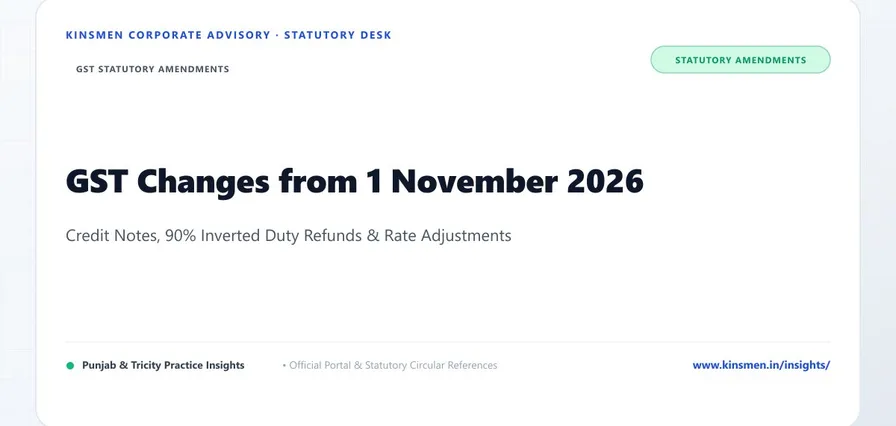
Significant statutory amendments to the Central Goods and Services Tax (CGST) Act took effect on 1 November 2026. Key reforms include stricter conditions under Section 15 and Section 34 for reducing output tax liability via post-sale discount credit notes, and a transformative amendment to Section 54(6) granting 90% provisional refund approval within 7 days for Inverted Duty Structure claims. Traders, textile mills, and engineering manufacturers in Punjab must update accounting procedures to ensure buyer-side ITC reversals and accelerate working capital recovery.
Key Takeaways
- Stricter Credit Note Matching: Under amended Section 34, suppliers can reduce output tax on discount credit notes only if the buyer has formally reversed corresponding ITC.
- 90% Provisional Refund for Inverted Duty: Manufacturers suffering from higher tax on inputs than on outputs now receive 90% provisional refunds within 7 days under Section 54(6).
- Section 15(3)(b) Documentation: Post-supply discounts must be established in terms of pre-existing agreements linked to specific original invoices.
- Financial vs Tax Credit Notes: Clear distinction enforced between GST tax credit notes (with tax adjustment) and commercial credit notes (accounting adjustments only).
- Textile & Agro Impact: Provides substantial working capital relief to spinning mills in Malerkotla, hosiery units in Ludhiana, and sports goods exporters in Jalandhar.
- Audit Defense: Kinsmen provides document verification and refund filing support to prevent Rule 88D tax mismatch notices.
Detailed Overview of the 1 November 2026 GST Amendments
The GST Council and CBIC enacted these legislative revisions to eliminate two persistent industry challenges: delayed refund disbursements for domestic manufacturers, and revenue leakages arising from unverified post-sale discount credits.
Here is the operational breakdown of the amended statutory sections:
| Statutory Section | Legal Subject | Previous Provision | Amended Provision (From Nov 2026) |
|---|---|---|---|
| Section 15(3)(b) | Post-Sale Discounts | Discount agreement needed, manual buyer confirmation | Automated portal matching with buyer’s GSTR-3B reversal |
| Section 34(2) | Tax Credit Notes | Unilateral adjustment allowed subject to subsequent audit | Output tax reduction contingent on buyer’s verified ITC reversal |
| Section 54(6) | Provisional Refunds | 90% provisional refund allowed only for zero-rated exports | Extended to Inverted Duty Structure (Rule 89(5)) claims |
| Rule 89(5) | Inverted Refund Formula | Prolonged verification of input service vs input goods credit | Streamlined automated computation excluding capital goods |
To learn how our team secures pending refunds, review our GST Refund Practice.
Stricter Conditions on Post-Sale Credit Notes (Section 15 & 34)
In commercial trade across Punjab, distributors and wholesalers routinely issue volume rebates, turnover discounts, and seasonal price adjustments through credit notes.
Mandatory Conditions to Reduce Supplier Output Tax Liability:
- Pre-Existing Contractual Agreement: The discount agreement must have been established in writing on or before the time of supply under Section 15(3)(b)(i).
- Invoice-Level Linkage: The credit note must explicitly reference the original invoice number, invoice date, and taxable value.
- Verified Reversal by Recipient: The buyer must reverse the input tax credit attributable to the discount in their monthly Form GSTR-3B under Table 4(B)(2).
        [Supplier Issues Tax Credit Note u/s 34]
                          |
             Matches Original Invoice Data
                          |
          Portal Checks Recipient's Form GSTR-3B
                          |
        -------------------------------------
        |                                   |
  Buyer REVERSED ITC               Buyer DID NOT Reverse ITC
        |                                   |
  Supplier's Output Tax             Supplier's Reduction DENIED;
  Reduction ALLOWED                 Tax must be settled with interest
Commercial / Financial Credit Notes Alternative:
If a supplier grants an ad-hoc commercial discount that was not agreed upon prior to supply, the supplier cannot issue a GST tax credit note.
Instead, they must issue a Financial / Commercial Credit Note without adjusting CGST/SGST/IGST. The buyer does not need to reverse ITC, and the supplier absorbs the tax originally discharged.
For professional tax structuring, explore our GST Advisory Services.
90% Provisional Refund for Inverted Duty Structure (Section 54(6))
One of the most consequential liquidity reforms in the amended rules is the expansion of Section 54(6).
Historically, manufacturers operating under an Inverted Duty Structure (where inputs carry a higher tax rate than finished outputs, such as 18% on polyester/nylon yarn versus 5% on woven fabric) waited 60 to 120 days for departmental verification before receiving any refund.
The New Provisional Sanction Protocol:
- 7-Day Turnaround: The tax officer is mandated to sanction 90% of the claimed refund amount provisionally within 7 working days from the date of issuance of the Application Reference Number (ARN) via Form GST RFD-04.
- Remaining 10%: Disbursed after comprehensive verification of purchase ledgers within the standard 60-day window via final order in Form GST RFD-06.
- Immediate Bank Credit: Approved funds are transferred directly into the taxpayer’s designated bank account via automated Public Financial Management System (PFMS) validation.
For related procedural rules on new registrations, see our analysis of 3-Day Simplified GST Registration.
Comparison: Old vs Amended GST Refund Process
| Feature | Pre-November 2026 Process | Amended Process (Post-1 November 2026) |
|---|---|---|
| Inverted Duty Provisional Refund | 0% (Full claim held until audit) | 90% provisional sanction within 7 days |
| Application Form | Form GST RFD-01 | Form GST RFD-01 (Automated Inverted Formula) |
| Issuance of Provisional Order | Not available for inverted duty | Form GST RFD-04 issued within 7 days |
| Buyer ITC Reversal Verification | Manual CA certificate / confirmation letters | Automated GSTN portal cross-validation |
| Capital Goods Treatment | Excluded from inverted formula | Excluded (reaffirmed statutory stance) |
| Interest on Delayed Refunds | 6% per annum after 60 days u/s 56 | 6% per annum after 60 days u/s 56 |
Step-by-Step Procedure to File for Inverted Duty Refunds
To leverage the 90% provisional refund provision without experiencing officer queries, follow this sequential procedure:
- Step 1: Perform Inward Ledger Audit
Reconcile purchase invoices with GSTR-2B. Exclude input services and capital goods invoices from the net ITC pool, maintaining only eligible input goods under Rule 89(5). - Step 2: Compute Adjusted Total Turnover
Determine total turnover of inverted rated supplies of goods, exempt supplies, and non-inverted supplies for the refund period. - Step 3: Execute Refund Application in Form GST RFD-01
Select category “Refund on account of Inverted Duty Structure”. Upload statement 1A detailing inward supply invoices and corresponding outward supply invoices. - Step 4: Generate Electronic ARN
Submit the application with Class-3 DSC on gst.gov.in. The portal generates an electronic ARN. - Step 5: Track Form GST RFD-04 Provisional Order
Within 7 days of ARN generation, monitor portal communications for the provisional sanction order (Form GST RFD-04) releasing 90% of the claimed sum. - Step 6: Settle Final Verification (RFD-06)
Furnish sample invoices and payment proofs if requested under Form GST RFD-08 to clear the remaining 10% balance under Form GST RFD-06.
If your claim encounters departmental queries or audit objections, consult our GST Notice Reply team.
Common Compliance Traps and Penalty Provisions
Failure to adhere to the revised credit note and refund conditions triggers rigorous statutory liabilities:
| Compliance Default | Legal Provision | Statutory Consequence |
|---|---|---|
| Output Tax Reduction Without Buyer ITC Reversal | Section 34(2) & Section 73/74 | Full tax recovery plus 18% interest under Section 50 |
| Incorrect Inverted Duty Refund Formula | Section 54 read with Rule 89(5) | Rejection of claim and recovery of excess refund with 18% interest |
| Inclusion of Input Services in Inverted Net ITC | Explanation to Rule 89(5) | Automated formula rejection by portal validation engine |
| Delayed Filing of RFD-01 | Section 54(1) | Time-barred after 2 years from the due date of return |
Local Punjab Industry Impact: Ludhiana, Malerkotla, Jalandhar & Amritsar
The November 2026 revisions directly impact key manufacturing and trade sectors across Punjab:
- Ludhiana Hosiery & Textile Clusters: Spinning and dyeing units operating under inverted duty ratios (18% on specialty chemicals and yarn versus 5% on woven garments) unlock liquidity through 90% provisional refunds.
- Malerkotla Power Loom & Fabrication Units: Small weaving and metal fabrication enterprises must establish clear volume discount agreements with raw material suppliers to avoid disallowed credit notes.
- Jalandhar Sports Goods & Leather Exporters: Exporters must reconcile commercial volume rebates to prevent foreign trade inward remittance discrepancies.
- Amritsar Shawl & Textile Printing Mills: Textile processors must ensure post-sale credit notes for fabric returns are reported before the end of the financial year.
Kinsmen Corporate Services advises manufacturing enterprises across Ludhiana, Malerkotla, Jalandhar, and Amritsar through our indirect tax team.
Frequently Asked Questions
What are the major GST amendments that took effect on 1 November 2026?
The primary amendments include: Section 34 revision establishing automated validation that buyers reversed ITC before sellers reduce output tax liability on credit notes; Section 54(6) amendment granting 90% provisional refund on inverted duty structure claims; and updated rate classifications impacting synthetic fabrics, agricultural machinery parts, and specialized packaging.
How do the new post-sale credit note rules under Section 34 affect manufacturers?
Under amended Section 34, a supplier issuing a tax credit note for post-sale volume discounts can only adjust their output tax liability if the recipient has reversed the corresponding input tax credit in their GSTR-3B. The GST portal now tracks this correlation through automated matching between Table 9B and recipient return data.
Who is eligible for the 90% provisional GST refund under Section 54(6)?
Previously, 90% provisional refunds were limited to exporters making zero-rated supplies without payment of tax. The amended rule extends 90% provisional sanction within 7 days of acknowledgment to manufacturers claiming accumulated ITC under the Inverted Duty Structure (Rule 89(5)), significantly improving liquidity for Punjab spinning and textile units.
What is the difference between a financial credit note and a tax credit note under GST?
A tax credit note issued under Section 34 reduces both the taxable value and the output tax liability of the supplier, requiring corresponding ITC reversal by the buyer. A financial or commercial credit note adjusts only the commercial receivable balance without adjusting GST, making it suitable for secondary discounts not agreed upon prior to supply.
What happens if a buyer fails to reverse ITC on a post-sale credit note?
If the recipient fails to reverse input tax credit, the supplier’s claim for tax adjustment will be denied during portal validation, or recovered with 18% interest under Section 50. The supplier must maintain documentary proof of the pre-supply discount agreement under Section 15(3)(b).
How do Punjab textile and power loom units claim the expedited 90% refund?
Textile units in Ludhiana and Malerkotla must file Form GST RFD-01 under the inverted duty category. Once the Application Reference Number (ARN) is generated and preliminary validation succeeds, the tax officer issues a provisional refund order in Form GST RFD-04 for 90% of the admissible claim within 7 working days.
Official Government Portals & Statutory Sources
- GST Portal: gst.gov.in — Form GST RFD-01 application gateway and credit note reconciliation.
- Central Board of Indirect Taxes and Customs: cbic-gst.gov.in — Statutory circulars on Section 15, Section 34, and Section 54 amendments.
- Punjab State Taxation Department: taxation.punjab.gov.in — State tax circle jurisdiction guidance and refund audit processing.
Consult Kinsmen for GST Refund & Advisory Support
Unlock accumulated inverted duty refunds and ensure post-sale credit notes comply with statutory standards. Contact our indirect tax team in Amargarh.
- Direct Phone: +91 99143-14949
- WhatsApp Inquiry: Direct WhatsApp Consultation
- Office Location: Shop No. 1, Nabha Malerkotla Road, Amargarh – 148022, District Malerkotla, Punjab
- Online Form: Schedule a Consultation via Contact Desk
Have a question about how this applies to your business?
Speak directly with our senior compliance partners in Amargarh. We review your entity structure, notices, and pending filings with zero middlemen.
Related Advisory & Compliance Execution
Need professional assistance with filing, notice defense, or entity structuring?
Partnership Firm Registration (Sec 58)
Custom partnership deed drafting compliant with revised Section 194T.
Tax Audit Facilitation (Section 44AB)
Form 3CD compilation, ledger vouching, and disallowance defenses.
Corporate Tax Planning & Advance Tax
Quarterly tax liability computation and 115BAA corporate opt-in advisory.
Related Practice Insights
More statutory analysis and practical compliance guides
Advance Tax Due Date December 2026: 3rd Instalment Calculation in Punjab
Advance tax due date December 2026: 75% cumulative tax by 15 Dec. Learn Section 234C & 234B interest calculations, senior citizen exemptions, and Punjab rules.
Learn More Advance Tax Due Date December 2026: 3rd Instalment Calculation in Punjab
AOC-4 MGT-7 Due Date FY 2025-26: MCA Annual Filing Rules for Punjab Companies
AOC-4 MGT-7 due date for FY 2025-26: 30 & 60 days post-AGM. Learn MCA late fee of ₹100/day, director KYC rules, LLP Form 11/8, and Punjab filing steps.
Learn More AOC-4 MGT-7 Due Date FY 2025-26: MCA Annual Filing Rules for Punjab Companies
Belated ITR Last Date 2026: Section 139(4), Fees & Loss Rules for AY 2026-27
Belated ITR last date for AY 2026-27 is 31 Dec 2026. Learn late fee u/s 234F, loss carry-forward rules, revision steps u/s 139(5), and ITR-U penalty rates.
Learn More Belated ITR Last Date 2026: Section 139(4), Fees & Loss Rules for AY 2026-27